
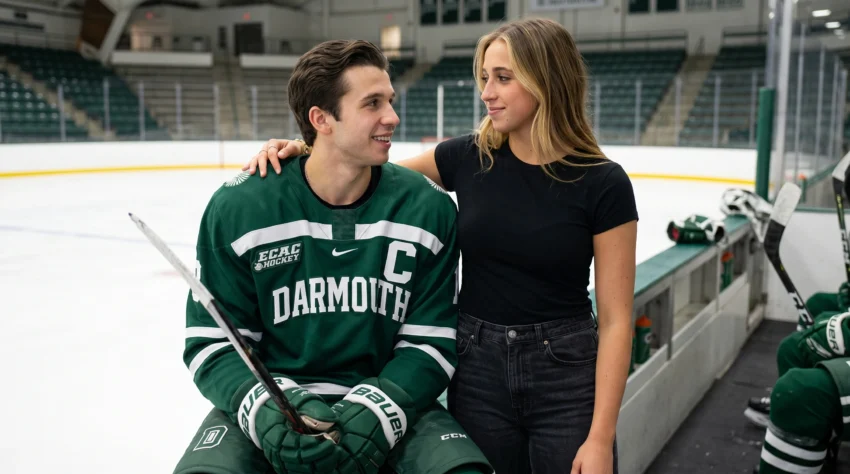
Tucker McRae is often introduced to the wider public through someone else’s spotlight. To many casual readers, he is the older brother of Tate McRae, the Canadian singer, dancer, and songwriter whose career has carried the McRae name far beyond Calgary. But Tucker’s own public story belongs first to hockey: the rinks he grew up around, the junior years that shaped him, and the Dartmouth College career that made him a team captain. His biography is not a celebrity tale in the usual sense, and that is exactly what makes it worth telling carefully.
McRae’s public profile sits in a rare place between college athletics and pop-culture curiosity. He has not built a career by courting fame, selling a persona, or turning family attention into a personal brand. Instead, the record that exists around him is mostly made of rosters, game notes, team announcements, school biographies, and the occasional family reference from Tate’s world. The result is a quieter portrait: a Calgary-born athlete whose life has become searchable because of both his own achievements and his sister’s global audience.
The verified picture is clear enough without exaggeration. Tucker McRae is a Canadian defenceman from Calgary, Alberta, who played junior hockey with the Okotoks Oilers before joining Dartmouth men’s hockey. He became Dartmouth’s captain for the 2025-26 season, a leadership role that placed him at the center of one of the program’s strongest modern chapters. He is also part of a close family whose two children pursued very different forms of performance under pressure: one on stage, the other on ice.
Early Life and Family Background
Tucker McRae was born in Calgary, Alberta, and grew up in a family that would later become familiar to fans of contemporary pop music. His parents are Todd McRae and Tanja Rosner, and his younger sister is Tate McRae. Public reporting has described the family as close, athletic, and supportive, with both children developing serious interests from a young age. Tucker’s path led toward hockey, while Tate’s led toward dance, songwriting, and global pop stardom.
The family’s story includes a period outside Canada during Tate’s early childhood, when the McRaes lived in Muscat, Oman, because of Todd McRae’s work. They later returned to Calgary, where both children continued growing into their separate ambitions. Calgary matters in Tucker’s biography because it is a serious hockey city, shaped by cold winters, outdoor rinks, local clubs, and a culture that treats the sport as part of everyday life. For a young player, that setting can make hockey feel less like an extracurricular activity and more like a language everyone around you understands.
Tucker attended Edge School in the Calgary area, a school known for combining academics with athletic development. That environment fit a player trying to manage both his studies and the demands of competitive hockey. He was not simply drifting through youth sports; he was part of a development path that required travel, training, discipline, and decisions about what kind of player he could become. The public record suggests that patience became one of the defining features of his early career.
The McRae family connection draws attention because Tate is famous, but Tucker’s upbringing should not be reduced to being near fame. He was the older sibling moving through his own athletic life before Tate became widely known. That timing matters because it shows that his hockey identity was not created as an accessory to a celebrity story. It was already there, built through local teams, school commitments, and the slow work of becoming reliable enough for the next level.
A Calgary Hockey Upbringing
Calgary is a practical place to fall in love with hockey. The sport is visible in community arenas, school conversations, youth leagues, and the larger identity of a city that has long supported both professional and grassroots hockey. Tucker McRae grew up in that environment, where the path from neighborhood rinks to organized competition is familiar to many families. His early hockey years appear to have followed that classic Canadian route: local development, serious school-athlete training, and then junior hockey.
Public hockey databases list Glenlake Hawks as one of McRae’s early youth associations. That detail may seem small, but it places him inside the Calgary minor hockey system before his later move into junior competition. Players who emerge from those systems often learn quickly that talent is only part of the equation. Ice time, coaching trust, physical maturity, and academic planning all shape whether a player can keep moving forward.
McRae’s later profile as a defenceman also fits the kind of player who often develops through repetition rather than flash. Defencemen are judged by positioning, decision-making, physical courage, and the ability to limit mistakes under pressure. A forward can sometimes earn attention through scoring bursts, but a defenceman’s value is often measured by what does not happen: the pass cut off, the shooting lane blocked, the rush slowed before it becomes dangerous. That kind of role rewards maturity, and McRae’s career would come to reflect that.
Not many people know this, but college hockey players often arrive later than fans of other college sports might expect. Many spend extra years in junior leagues after high school, gaining strength, experience, and academic readiness before joining NCAA programs. McRae’s route fits that pattern. Rather than rushing into the next step, he built toward it through junior hockey and a record of both athletic and academic credibility.
Junior Hockey with the Okotoks Oilers
Before Dartmouth, Tucker McRae played for the Okotoks Oilers in the Alberta Junior Hockey League. Okotoks, located south of Calgary, has long been a meaningful stop for players trying to reach college hockey or higher levels of the sport. The AJHL is not just a place to collect points; it is a demanding junior environment where young players learn how to handle travel, older competition, and the expectations of playing a structured team game. For McRae, it became the bridge between Calgary development and NCAA hockey.
His final season with the Oilers showed the strongest offensive production of his publicly documented career. Dartmouth’s athletic biography credits him with 38 points in 58 games during the 2021-22 season, including six goals and 32 assists. For a defenceman, that is a meaningful line because it signals puck movement, confidence, and enough offensive awareness to help drive play from the blue line. It also helped explain why a strong academic school with a Division I hockey program would see value in him.
McRae was named the Oilers’ Defenseman of the Year, another marker of how he was viewed inside the team. He was also recognized on the AJHL All-Academic Team, which matters because Ivy League hockey programs do not recruit athletic ability alone. Dartmouth had to see a player who could handle the classroom as well as the rink. That academic thread stayed visible throughout his public profile.
Leadership also became part of his junior identity. McRae served as captain in his final season with Okotoks, giving him a role that required more than showing up for shifts. Captains help set practice habits, speak for teammates, manage standards, and carry pressure when a team hits rough stretches. By the time he arrived at Dartmouth, he already knew what it meant to be trusted with a letter on his jersey.
Dartmouth and the Move to NCAA Hockey
Tucker McRae joined Dartmouth College’s men’s hockey program as a defenceman, entering a level where speed, structure, and depth can quickly change a player’s role. Dartmouth competes in ECAC Hockey, a conference with strong academic institutions and serious hockey programs. For players coming from junior leagues, the adjustment can be sharp. They must adapt to older opponents, limited mistakes, and coaches who assign roles based on team needs rather than past scoring totals.
As a freshman in the 2022-23 season, McRae appeared in 29 games for the Big Green. Dartmouth’s records credit him with his first collegiate point on an assist at Rensselaer in November 2022 and his first college goal against Clarkson in January 2023. He also finished near the top of the team in blocked shots, an early sign of how his college value would be measured. That first season introduced him as a player willing to defend hard minutes rather than chase only visible offensive moments.
His sophomore season in 2023-24 brought his best college scoring output. He played 27 games and recorded three goals, four assists, and seven points. The scoring increase showed that he could still contribute with the puck, but the defensive details remained central. He again ranked highly among Dartmouth players in blocked shots, continuing the profile of a defenceman trusted to get in lanes and take on difficult defensive work.
By his junior season, his offensive numbers fell, but his place in the team structure remained. He played 26 games in 2024-25 and continued to block shots while serving as part of Dartmouth’s defensive group. For readers used to judging athletes by goals and assists, that may look like a step back. In reality, college hockey coaches often value players who accept tighter roles, especially if they are dependable in situations that do not create headlines.
Becoming Dartmouth Captain
Dartmouth named Tucker McRae captain for the 2025-26 season, a major personal milestone and a clear sign of trust from the program. The announcement placed him at the front of a leadership group that also included assistant captains Eric Charpentier, CJ Foley, Alex Krause, and Cam MacDonald. Captains at the college level are rarely chosen for statistics alone. Coaches look for steadiness, respect inside the room, and a player who can carry standards when no crowd is watching.
McRae entered that senior season with more than 80 games of Dartmouth experience. He had built a record as a shot blocker, penalty-kill contributor, and low-maintenance defensive presence. Those are not the easiest traits to market, but they are the kind coaches tend to remember. A player who can be trusted without constant management often becomes more valuable as a team grows more ambitious.
The captaincy also connected back to his junior years in Okotoks. McRae had already worn a letter before, and Dartmouth’s decision suggested that leadership style translated across levels. It is one thing to be respected in junior hockey, where players are still teenagers or barely older. It is another to earn the same kind of confidence in an Ivy League college locker room with players from different backgrounds, leagues, and expectations.
What’s surprising is how quiet the public version of that leadership remains. McRae does not appear to have built a loud media personality around the role. His leadership reads instead as the kind based on consistency, defensive habits, and the willingness to do work that rarely becomes a highlight. In a sport that values trust, that can be as meaningful as any scoring streak.
The 2025-26 Season and a Historic Dartmouth Run
The 2025-26 season gave Tucker McRae’s Dartmouth career a larger frame. As captain, he helped lead the Big Green through a year that ended with one of the most important achievements in program history. Dartmouth won the ECAC Hockey Championship in March 2026, defeating Princeton 2-1 in overtime at Herb Brooks Arena in Lake Placid. The victory gave Dartmouth the conference’s automatic NCAA Tournament bid and marked the program’s first ECAC title.
The championship game itself had the rhythm of a tight college hockey final. Dartmouth took an early lead, Princeton pushed back, and the game moved into overtime with little room for error. Tim Busconi scored the winner, but a title game like that is rarely about one player alone. It is the product of goaltending, defensive structure, special teams, patience, and a room that can handle long stretches of pressure.
For McRae, the title gave his captaincy a permanent place in Dartmouth hockey history. He was not the offensive star of the final, and his season stat line did not make him the first name in every recap. But captains are tied to team identity, especially during seasons that end with banners. His role was to help hold together a group that reached a level Dartmouth had been chasing for decades.
Dartmouth’s NCAA Tournament return after the ECAC title also mattered. It placed the program back on a national stage and gave the senior class a finish with rare weight. For a player from Calgary who had worked through junior hockey, academics, and four college seasons, that ending gave shape to the long route. It was not a story of overnight arrival; it was a story of staying long enough to become part of something bigger.
Playing Style and Strengths
Tucker McRae’s hockey profile is best understood through role, not scoring totals. At Dartmouth, he was a defenceman whose public record points toward shot blocking, penalty killing, and responsible minutes. Those duties require a player to read danger early and accept physical costs without much public reward. In hockey rooms, that kind of work often carries more respect than casual box-score readers realize.
As a junior player, McRae showed more offensive production, especially with the Okotoks Oilers. His 32 assists in the 2021-22 season suggest he could move the puck and support offense from the back end. At the college level, his role shifted toward defense and containment. That transition is common because NCAA teams are deeper, faster, and more specialized.
His listed size, around 6 feet and 200 pounds, gave him the build of a sturdy college defenceman rather than an undersized puck specialist. Being a left shot also shaped how coaches could place him within defensive pairings. In hockey, handedness matters because it affects breakout angles, board play, and how a defenceman handles pressure on either side of the ice. Those small tactical details influence who plays where, even if fans rarely discuss them.
The strongest public description of McRae is not “star” in the celebrity sense or “prospect” in the draft-hype sense. It is “trusted.” He was trusted in junior hockey, trusted enough to captain Okotoks, and later trusted enough to captain Dartmouth. That pattern tells readers more about him than an inflated label would.
Education and Academic Profile
Dartmouth’s roster identifies Tucker McRae as a senior and lists his major as government. Earlier biographical text connected him to economics and a possible interest in business, which may reflect an earlier academic plan rather than his final listed field of study. That kind of shift is common among college students, including athletes whose schedules already demand more structure than most of their classmates face. The current public school listing gives government as the safest description of his academic focus.
The academic side of McRae’s path is not a minor detail. Dartmouth is an Ivy League institution, and playing Division I hockey there means balancing elite athletics with a serious classroom environment. Practices, travel, workouts, film sessions, and games all compete with exams, papers, and long-term academic requirements. Athletes who stay through four years in that setting generally need discipline beyond the rink.
His earlier AJHL academic recognition fits this part of the story. Being named to an all-academic team does not guarantee later success, but it does show that academics were part of how he was evaluated before college. For a player pursuing NCAA opportunities, grades and eligibility can shape the range of possible schools. McRae’s Dartmouth path suggests he was able to keep both sides of that equation alive.
There is also a quiet contrast with Tate McRae’s career here. Tate’s work moved through performance, recording, touring, and the demands of entertainment at a young age. Tucker’s path moved through school, hockey systems, and a more private version of discipline. Both required pressure management, but they played out in very different public settings.
Relationship with Tate McRae
Tucker and Tate McRae’s sibling relationship is one of the main reasons many readers search for him. Tate has spoken publicly through music and social media in ways that make clear her brother matters to her. She wrote “Dear Brother,” a song addressed to him, and has referenced family and Calgary in her work. Fans who follow Tate closely often become curious about the people who shaped her life before fame.
Tucker has appeared in Tate’s public orbit without seeming to chase the spotlight for himself. Reports and social posts have placed him around her tour life, family celebrations, and supportive moments. He has also shown up as part of the grounded family background that fans often look for in a young artist’s story. That presence is familiar but not overly exposed.
The sibling dynamic also gives readers a more complete view of the McRae family. One child became a globally recognized entertainer; the other became an Ivy League hockey player and team captain. Those are very different achievements, but both require discipline, competitiveness, and the ability to perform under scrutiny. In that sense, Tucker and Tate’s paths look less separate than they first appear.
That said, Tucker’s biography should not become a side chapter in Tate’s. He is part of her story, and she is part of his, but he has his own record. Reducing him to a celebrity sibling would miss the years of junior hockey, college athletics, academic work, and leadership that form the backbone of his public identity. The better reading is simple: he is both Tate McRae’s brother and a serious athlete in his own right.
Public Image and Privacy
Tucker McRae’s public image is unusually restrained for someone connected to a major pop star. He does not appear to have pursued celebrity coverage as a main project, and most reliable information about him comes from sports institutions rather than entertainment media. That gives his profile a different texture from the online biographies that often surround relatives of famous people. There is less spectacle, but there is also less noise.
This restraint matters because it protects the line between public record and private life. The public can fairly discuss his hockey career, school, family relationship, and documented achievements. It should be much more careful around dating claims, private finances, or personal habits that have not been confirmed by credible sources. Curiosity is natural, but it does not turn speculation into biography.
His social image, where visible, appears tied to family support and hockey rather than personal branding. That fits the way many college athletes present themselves, especially those who are not trying to become influencers. They may be public enough to be recognized by fans, but still private enough that much of their real life remains offline. McRae seems to occupy that middle ground.
The truth is, this makes the biography stronger if handled honestly. A writer does not need invented drama to explain why Tucker McRae is interesting. His story already has family fame, Canadian hockey culture, an Ivy League education, junior leadership, college captaincy, and a championship season. Those facts are enough.
Money, Income Sources, and Net Worth
There is no credible public record confirming Tucker McRae’s personal net worth. Some online biography pages may attach estimates to his name, but those figures should be treated cautiously unless they are tied to documented income, contracts, business filings, or verified endorsements. As a college athlete, his financial picture is not comparable to that of an established professional player or his globally famous sister. Any precise net worth claim would be unreliable without stronger evidence.
His known public income opportunities would have been limited by his status and career stage. NCAA athletes can now earn money through name, image, and likeness opportunities, but there is no widely confirmed public figure showing what McRae earned, if anything, from NIL activity. He also has no verified NHL contract or publicly documented professional hockey salary. That means the responsible answer is that his net worth is unknown.
His possible long-term income sources may come from hockey, business, or another career after Dartmouth. Dartmouth’s older bio text mentioned an interest in business, while his listed academic major is government. Those details suggest broad post-college possibilities, but they do not establish a specific career move. Until McRae or an official organization announces his next step, it is best not to guess.
This is one area where careful language is especially important. Readers often search for “net worth” because it feels like a quick measure of status. For Tucker McRae, it is more accurate to say that his public value lies in his athletic and academic record, not in any verified fortune. The available facts do not support turning him into a financial headline.
Relationships and Personal Life
Tucker McRae’s romantic life is not clearly documented in reliable public sources. There is no widely confirmed public record of a spouse, children, or an official engagement. Because he is not a public entertainer or elected figure, that privacy deserves respect. A biography can be complete without inventing a relationship section from social-media scraps.
His closest publicly confirmed family relationships are with his parents and his sister, Tate. Dartmouth’s own player materials identify his parents and mention his sibling, while entertainment reporting has described his bond with Tate in more detail. Those are fair details to include because they have appeared in credible public contexts. They also help explain why his name reaches readers beyond college hockey circles.
McRae’s interests outside hockey, as listed in his Dartmouth biography, include golf and playing guitar. Those details are small but useful because they show a fuller person without crossing into private territory. They also fit naturally within a family where music and performance are close by, even if Tucker’s main public path has been athletic. A detail like guitar does not make him a musician in the public sense, but it adds texture to the portrait.
Public figures connected to celebrities often become targets for overreading. A photo, follow, or appearance can turn into a rumor before anyone involved has said anything. That is not good biography. The responsible version leaves his private life private and focuses on the parts of his life he or his institutions have made public.
Where Tucker McRae Is Now
As of the most recent public record, Tucker McRae was a senior defenceman and captain for Dartmouth during the 2025-26 hockey season. That season ended with Dartmouth’s ECAC championship and NCAA Tournament appearance, giving his college career a major final chapter if he completed eligibility that year. His next public step has not been firmly established through a verified professional team announcement. That leaves his future open rather than settled.
He could continue in hockey if an opportunity fits, as many NCAA players move into professional leagues in North America or Europe after college. He could also move into business, public policy, sports, or another field connected to his studies and interests. The public record does not yet show which path he has chosen. For now, any claim that he has signed somewhere or taken a specific job should be treated as unconfirmed unless it comes from an official source.
What is clear is that his Dartmouth career ended, or was nearing its end, with stronger visibility than it began. He arrived as a junior hockey recruit from Alberta and became a senior captain on a championship team. That is a meaningful arc in college athletics. It does not require a professional contract to matter.
His current public image remains tied to both hockey and family. Fans of Tate McRae may still search his name out of curiosity, while hockey readers may remember him through Dartmouth’s title season. Those two audiences do not always overlap, but they meet in his biography. Tucker McRae’s story belongs at that intersection.
Frequently Asked Questions
Who is Tucker McRae?
Tucker McRae is a Canadian hockey player from Calgary, Alberta, best known as a defenceman for Dartmouth College men’s hockey. He played junior hockey for the Okotoks Oilers before joining Dartmouth and later became captain of the Big Green for the 2025-26 season. Outside hockey, many people know him as the older brother of singer Tate McRae.
Is Tucker McRae related to Tate McRae?
Yes, Tucker McRae is Tate McRae’s older brother. Their parents are Todd McRae and Tanja Rosner, and the siblings were raised largely in Calgary after the family returned from living abroad during Tate’s early childhood. Tate has publicly referenced Tucker in her music and social media, which has increased curiosity about him.
What sport does Tucker McRae play?
Tucker McRae plays ice hockey and is a defenceman. He played for the Okotoks Oilers in the Alberta Junior Hockey League before moving to NCAA Division I hockey at Dartmouth College. His college profile is built around defensive responsibility, blocked shots, penalty-kill work, and leadership.
How old is Tucker McRae?
Public hockey databases list Tucker McRae’s birthdate as April 11, 2001. That makes him 25 years old as of May 2026. He was born in Calgary, Alberta, and is listed as a Canadian player.
Was Tucker McRae Dartmouth’s captain?
Yes, Tucker McRae was named captain of Dartmouth men’s hockey for the 2025-26 season. The appointment followed earlier leadership experience with the Okotoks Oilers, where he had also served as captain. His Dartmouth captaincy became especially meaningful because the team won the ECAC Hockey Championship that season.
What is Tucker McRae’s net worth?
Tucker McRae’s net worth is not publicly confirmed by reliable sources. Some websites may publish estimates, but those figures are not supported by verified contracts, business records, or official earnings information. The most accurate answer is that his finances are private and any precise public estimate should be treated with caution.
Is Tucker McRae an NHL player?
Tucker McRae is not publicly verified as an NHL player or NHL draft pick. His confirmed hockey record includes junior hockey with the Okotoks Oilers and NCAA Division I hockey with Dartmouth College. If he continues professionally after Dartmouth, that status should be confirmed through an official team or league announcement.
Conclusion
Tucker McRae’s biography is most interesting when it is allowed to stay grounded. He is not simply a name attached to Tate McRae, and he is not a celebrity figure built from vague online claims. He is a Calgary athlete who moved through junior hockey, earned a place at Dartmouth, became a college captain, and helped lead a historic team season.
His story also shows how public attention can find someone who has not necessarily asked for it. Because his sister is famous, readers want to know who he is, what he does, and whether there is more to his life than a family connection. The answer is yes, though the “more” is not scandal or spectacle. It is work, school, hockey, leadership, and the discipline of a demanding sport.
The most respectful way to write about Tucker McRae is to keep the lens clear. His public record is strong enough without guessing about private relationships, money, or future plans. He matters because his own achievements are real, and because his life offers a quieter counterpoint to the louder world around a famous family name.
For now, Tucker McRae stands as a Dartmouth hockey captain from Calgary whose public story is still relatively young. Whether his next chapter is in hockey, business, or another field, the foundation is already visible. It was built on patience, family support, and the kind of leadership that often shows up most clearly when a team wins together.