
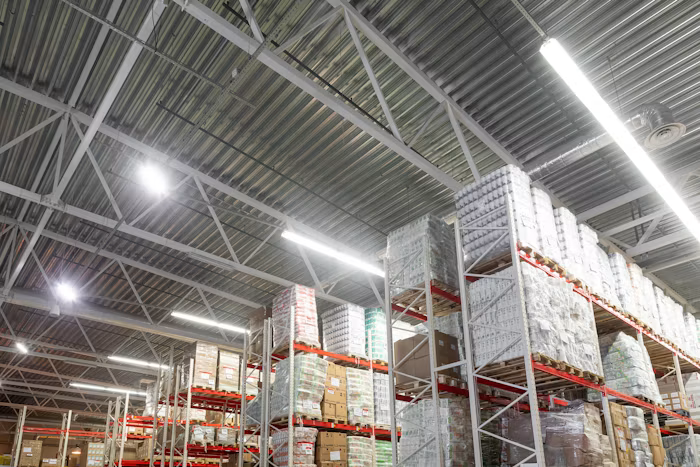
The Hidden Costs of Legacy Lighting in Industrial Facilities
For decades, industrial architects and facility managers relied on High-Pressure Sodium (HPS) and Metal Halide (MH) fixtures to illuminate massive manufacturing floors. While initially cost-effective to install, these legacy systems harbor significant hidden operational expenses. Their inherent inefficiency drains vast amounts of electrical power, converting much of it into wasted heat rather than usable light.
One of the most critical failures of traditional lighting is rapid lumen depreciation. Unlike modern alternatives, HPS and MH lamps lose a substantial percentage of their initial light output within the first few thousand hours of operation. This degradation directly compromises worker safety and reduces precision in manufacturing environments.
Beyond energy consumption, the maintenance burden of legacy systems is staggering. Replacing blown bulbs in high-ceiling warehouses requires specialized equipment, such as boom lifts or scaffolding. This physical replacement process inevitably leads to costly operational downtime and halts production lines.
Furthermore, the poor Color Rendering Index (CRI) of traditional high-intensity discharge lamps makes color differentiation difficult. In facilities where wiring assembly or quality control inspections take place, this optical deficiency can lead to expensive manufacturing errors and product recalls.
The Engineering Behind High-Bay LED Efficiency
The transition to Solid-State Lighting (SSL) represents a fundamental shift in industrial infrastructure. Rather than relying on pressurized gases and fragile filaments, modern LEDs generate photons through semiconductor electroluminescence. This direct conversion process is exponentially more efficient.
Deploying uniform, high-lumen output across a 100,000-square-foot facility requires lighting fixtures engineered with strict thermal and optical tolerances. Achieving this consistency at an industrial scale is highly demanding. For example, a leading commercial LED lighting manufacturer like WOSEN utilizes automated die-casting and stringent photometric testing to supply globally compliant fixtures, ensuring long-term stability for extensive European and international projects.
At the core of this sustained efficiency are advanced heat sinks. Because LEDs do not project heat forward via infrared radiation, the thermal load accumulates at the back of the diode. Precision-engineered aluminum heat sinks are critical for drawing this thermal energy away from the semiconductor, preventing catastrophic failure.
To meet industrial specifications, high-bay LED fixtures must deliver on several technical metrics:
- Luminous Efficacy: Achieving 150 to over 200 lumens per watt (lm/W).
- Color Rendering Index (CRI): Sustaining a CRI of >80 for accurate visual inspection.
- Beam Angle: Utilizing optimized polycarbonate lenses for 60°, 90°, or 120° light distribution.
- Power Factor: Maintaining a >0.95 power factor to minimize electrical grid strain.
Thermal Management and Lifespan
The functional lifespan of an industrial LED is inexorably linked to its junction temperature. This is the highest operating temperature of the actual semiconductor in the diode. If the junction temperature exceeds the manufacturer’s specified limits, the structural integrity of the diode degrades, accelerating lumen depreciation.
Effective thermal management keeps the junction temperature well below critical thresholds, enabling the fixture to easily surpass 50,000 to 100,000 hours of L70 operational life (the point at which light output drops to 70% of its initial value).
Additionally, the physical housing of the fixture plays a vital role in extreme environments. Industrial facilities are often exposed to heavy airborne particulates, chemical vapors, and moisture.
High-quality fixtures utilize robust sealing mechanisms to achieve strict ingress protection standards:
- IP65 Rating: Complete protection against dust ingress and resistance to low-pressure water jets.
- IP67 Rating: Complete dust protection and resistance to temporary liquid immersion.
- IK08/IK10 Ratings: High resistance to mechanical impacts and physical collisions.
Calculating the ROI of an LED Retrofit Project
For supply chain directors and facility managers, authorizing a massive lighting retrofit requires a bulletproof financial justification. Calculating the Return on Investment (ROI) involves auditing the current baseline energy draw and projecting the stabilized metrics of the new Solid-State Lighting infrastructure.
A standard ROI framework analyzes the wattage reduction per fixture multiplied by the facility’s annual operating hours. Because modern high-bay LEDs often consume 50% to 70% less power than equivalent metal halides, the kilowatt-hour (kWh) reduction is immediate and highly predictable.
Facility managers must also factor in the integration of smart controls. Equipping LEDs with passive infrared (PIR) motion sensors and daylight harvesting dimmers can drive energy consumption down by an additional 20% to 30%, drastically accelerating the payback period.
Energy Savings vs. Initial Capital Expenditure
The most common barrier to LED adoption is the initial Capital Expenditure (CapEx). High-quality industrial fixtures engineered with proper heat sinks and top-tier drivers require a significant upfront investment compared to legacy replacement bulbs.
However, evaluating this exclusively through a CapEx lens is a flawed financial model. Decision-makers must utilize a Total Cost of Ownership (TCO) framework. TCO accounts for the upfront cost, the compounded energy savings over a 10-year period, and the near-total elimination of maintenance labor and replacement parts.
When applied to a 24/7 manufacturing facility, the Total Cost of Ownership for an LED system typically reaches the break-even point within 14 to 24 months. Following this payback period, the operational savings directly increase the facility’s bottom-line profitability year over year.
Global Energy Standards Driving the Shift to Solid-State Lighting
The transition toward industrial LED infrastructure is no longer merely a financial optimization strategy; it is increasingly a strict legal requirement. Governments and international regulatory bodies are actively phasing out energy-dense lighting to combat industrial greenhouse gas emissions.
Compliance with updated building codes, such as California’s Title 24 or the EU’s Ecodesign Directive, mandates strict energy density limits (Watts per square foot) that legacy HPS and MH systems simply cannot achieve. Facilities failing to upgrade face heavy regulatory fines and carbon taxation.
Regulatory bodies worldwide are systematically phasing out inefficient lighting technologies to meet ambitious climate goals. According to comprehensive data from the US Department of Energy (DOE), the widespread adoption of industrial LED technologies is projected to save hundreds of terawatt-hours of electricity annually, fundamentally altering the carbon footprint of the manufacturing sector.
By proactively adopting globally compliant Solid-State Lighting, industrial architects ensure their facilities remain legally operational and future-proofed against tightening environmental legislation.
Conclusion
Upgrading a modern manufacturing facility to industrial LED infrastructure is far more than a routine maintenance task; it is a critical strategic asset upgrade. By mitigating the severe inefficiencies of legacy lighting, facilities immediately reduce operational overhead and carbon output.
When analyzing the profound impact of advanced thermal management, increased safety through superior visibility, and a rapidly decreasing Total Cost of Ownership, the business case for LED adoption becomes undeniable. Forward-thinking facility managers must view Solid-State Lighting not as an expense, but as a high-yield investment into the facility’s long-term operational resilience.