
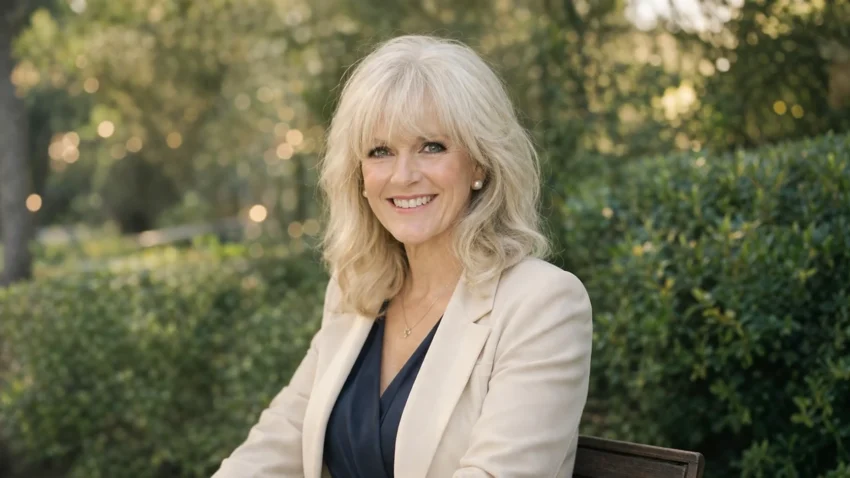
Barbara Boothe’s name surfaces most often in connection with one of Silicon Valley’s most recognizable figures, Oracle co-founder Larry Ellison. But that association, while accurate, only explains part of why people continue to search for her. The more revealing story lies in how little of her life has been made public—and how deliberately she appears to have built a life outside the glare that followed those early years. Her biography is not one of constant visibility or headline-making moves, but of selective presence: in a brief but consequential marriage, in the upbringing of two influential children, and in a quieter second chapter shaped around horses, land, and independence.
For readers expecting a conventional celebrity profile, Barbara Boothe can feel like an unfinished puzzle. There is no steady stream of interviews, no memoir, no carefully managed public persona. What exists instead is a sparse but consistent record that, when pieced together carefully, offers a grounded portrait of a woman connected to power yet largely uninterested in performing it.
Early Life and Background
The details of Barbara Boothe’s early life remain largely private, and that absence of information is itself telling. Unlike many individuals linked to high-profile figures, she has not had her upbringing widely documented or retold in interviews. There are no widely verified public accounts of her childhood, family background, or exact place of birth, and even basic biographical details such as her date of birth are inconsistently reported across secondary sources.
What can be said with reasonable confidence is that she came of age in California and entered the workforce at a time when Silicon Valley was still forming its identity. This was the late 1970s and early 1980s, a period when the tech industry had not yet solidified into the global powerhouse it would become. Jobs in early tech companies were often less formal, and entry points into the industry were more accessible than they would later be.
Barbara Boothe’s path into that world appears to have been through administrative work. She is widely described in biographical accounts of Larry Ellison as having worked as a receptionist at Relational Software, Inc. (RSI), the company that would later become Oracle. While that role may sound modest, it placed her at the center of a company that was beginning to expand rapidly and define a new sector of the economy.
Meeting Larry Ellison
Barbara Boothe met Larry Ellison during a period of intense growth and ambition in his professional life. RSI, founded in 1977, was gaining traction by building database systems based on relational models, an idea that would soon become central to enterprise computing. Ellison, already known for his drive and risk-taking, was pushing the company forward at a fast pace.
Their relationship developed within that environment, where long hours and close collaboration were common. The workplace culture of early Silicon Valley blurred lines between professional and personal life, and relationships formed within companies were not unusual. Boothe and Ellison’s connection followed that pattern, eventually leading to marriage in 1983.
The timing of their marriage is significant. Oracle Systems Corporation, as the company was renamed that same year, was entering a phase of rapid expansion. Revenues were climbing, and the company was positioning itself as a major player in a competitive and evolving market. Boothe’s marriage to Ellison placed her in proximity to this growth, even if she was not directly involved in the company’s leadership.
Marriage and Family Life
Barbara Boothe and Larry Ellison’s marriage lasted approximately three years, ending in divorce in 1986. During that time, they had two children: David Ellison and Megan Ellison, both born in the mid-1980s. Their arrival coincided with a pivotal period in Oracle’s development, when the company was transitioning from a startup into a major corporation.
The marriage itself has not been extensively documented in public sources, and neither Boothe nor Ellison has provided detailed accounts of their relationship. This absence of commentary has left much of the narrative undefined, beyond the basic facts of its duration and its outcome. What is clear is that the divorce occurred relatively early in both their lives, before Ellison reached the peak of his wealth and public visibility.
After the separation, Boothe appears to have stepped away from the public sphere. Unlike some former spouses of high-profile figures, she did not pursue media attention, publish accounts of her experiences, or maintain a visible social presence tied to Ellison’s rising fame. Instead, her life took a quieter path, centered around raising her children and later building her own independent pursuits.
Raising David and Megan Ellison
Barbara Boothe’s role as a mother is one of the most enduring aspects of her public identity, largely because of the prominence her children would later achieve. David Ellison and Megan Ellison grew up to become influential figures in the entertainment industry, each carving out distinct careers in film production and media.
David Ellison founded Skydance Media in 2010, a production company known for major film franchises and partnerships with studios. Over time, Skydance expanded into television, animation, and interactive media, becoming a significant player in Hollywood. In 2025, the company completed a high-profile merger with Paramount Global, positioning David Ellison as a central figure in a newly combined media entity.
Megan Ellison, by contrast, took a more auteur-focused approach to filmmaking. She founded Annapurna Pictures in 2011 and quickly earned a reputation for backing ambitious, director-driven projects. Films associated with Annapurna have received critical acclaim and major awards recognition, including multiple Academy Award nominations.
The success of both children has kept public interest in their family background alive, and by extension, in Barbara Boothe. Yet there is little direct commentary from her about their upbringing. The available record suggests that she played a central role in their early lives, but details about her parenting style, values, or influence are not widely documented in primary sources.
Life After Divorce
Following her divorce from Larry Ellison, Barbara Boothe largely withdrew from public attention. This decision stands in contrast to the trajectory of Ellison himself, whose wealth and influence grew dramatically in the decades that followed. Oracle became one of the world’s leading technology companies, and Ellison became one of the richest individuals globally.
Boothe’s post-divorce life did not mirror that visibility. Instead, she appears to have focused on building a life that was more private and self-directed. The lack of extensive media coverage during this period suggests a deliberate choice to remain outside the spotlight, even as her former husband’s profile expanded.
But here’s the thing: absence from headlines does not mean absence of activity. Over time, a clearer picture emerges of Boothe’s second chapter, centered on a long-standing interest in horses and equestrian life.
Wild Turkey Farm and the Equestrian World
One of the most concrete and verifiable aspects of Barbara Boothe’s later life is her involvement with Wild Turkey Farm, an equestrian operation associated with her under the name Barbara or Barb Ellison. The farm, originally established in California in 1989, later expanded to Wilsonville, Oregon, where it developed into a breeding and training facility.
The official materials associated with the farm describe her as the owner and an active participant in its operations. This suggests a level of long-term commitment that goes beyond a casual hobby. Equestrian work, particularly at the level of breeding and training, requires sustained investment, expertise, and day-to-day involvement.
What’s striking is how different this world is from the one she left behind. Silicon Valley’s rapid pace and high visibility stand in contrast to the rhythms of horse breeding and farm management. The shift reflects a broader pattern seen in some individuals connected to high-profile industries: a move toward pursuits that offer autonomy and a different kind of fulfillment.
Public reports have occasionally touched on the scale of the farm, including references to large acreage and significant property value. However, these details are not consistently documented across primary sources, and estimates should be treated cautiously. What is clear is that the farm represents a significant and enduring part of Boothe’s life.
Public Image and Privacy
Barbara Boothe’s public image is defined as much by what is not known as by what is. In an era where personal branding and constant visibility are often expected, her low profile stands out. She does not maintain a widely recognized public persona, and there is little evidence of engagement with media or social platforms.
This approach has had two effects. On one hand, it has preserved a degree of privacy that is increasingly rare for individuals connected to wealth and influence. On the other, it has created a vacuum that is often filled by speculation, inconsistent reporting, and recycled content.
The truth is that much of what circulates online about Boothe lacks strong sourcing. Claims about her early life, education, or personal finances often vary widely, and few are supported by primary documentation. For readers, this means that careful distinction between verified facts and unconfirmed claims is essential.
Financial Context and Net Worth
Estimating Barbara Boothe’s net worth is difficult, largely because there is no publicly disclosed financial profile tied directly to her. Some secondary sources attempt to assign figures, but these estimates are not backed by verifiable financial disclosures or authoritative reporting.
Her financial standing is sometimes discussed in relation to Larry Ellison’s wealth, which is substantial. However, the terms of their divorce have not been publicly detailed in a way that allows for precise conclusions about her personal assets. Any attempt to calculate her net worth based on those factors alone would be speculative.
What can be said is that her involvement in a large equestrian operation suggests access to significant resources. Horse breeding and farm ownership at that scale typically require ongoing investment. Beyond that, the specifics of her financial situation remain private.
Relationship to the Ellison Legacy
Barbara Boothe’s place in the broader Ellison family narrative is secure, even if her personal story is less visible. As the mother of David and Megan Ellison, she is connected to two influential branches of modern entertainment. Their work in film and media has extended the family’s reach beyond technology into cultural production.
At the same time, her own life has not been defined by those connections in a public-facing way. She has not positioned herself as a spokesperson for her children’s work or as a participant in the entertainment industry. This separation underscores a pattern that runs through her biography: proximity to influence without direct engagement in its public expression.
Where Barbara Boothe Is Now
The most recent publicly verifiable information places Barbara Boothe in Oregon, associated with Wild Turkey Farm and its ongoing operations. While there have been reports about property listings and potential sales, the farm continues to be presented as an active entity linked to her.
There is no clear indication that she has returned to public life in any conventional sense. Instead, her current status appears to reflect continuity rather than change. She remains connected to her established pursuits, maintaining a presence in the equestrian world rather than shifting toward more visible roles.
For many readers, this is part of what makes her story compelling. In a culture that often equates visibility with relevance, Boothe’s life suggests another model—one where influence is indirect, and where a person can remain connected to major public narratives without becoming a public figure themselves.
Frequently Asked Questions
Who is Barbara Boothe?
Barbara Boothe is best known as the former wife of Oracle co-founder Larry Ellison and the mother of film producers David and Megan Ellison. Her own public life is most clearly documented through her ownership of an equestrian operation known as Wild Turkey Farm. Beyond these roles, much of her personal biography remains private.
How long was Barbara Boothe married to Larry Ellison?
Barbara Boothe and Larry Ellison were married from 1983 until their divorce in 1986. Their marriage took place during a period of rapid growth for Oracle, but it ended before Ellison reached the peak of his public profile and wealth.
Does Barbara Boothe have children?
Yes, she has two children: David Ellison and Megan Ellison. Both are prominent figures in the entertainment industry, with David leading Skydance Media and Megan founding Annapurna Pictures. Their careers have contributed to ongoing public interest in Boothe.
What does Barbara Boothe do now?
Barbara Boothe is associated with Wild Turkey Farm, an equestrian facility in Oregon. She is described as the owner and is believed to be actively involved in its operations. This work represents the most visible aspect of her current life.
What is Barbara Boothe’s net worth?
There is no publicly verified figure for Barbara Boothe’s net worth. While some estimates appear online, they are not supported by reliable financial disclosures. Any discussion of her wealth should be treated as speculative.
Why is there so little information about Barbara Boothe?
Barbara Boothe has maintained a low public profile and has not engaged extensively with media or public platforms. As a result, much of her life has not been documented in detail, and reliable information is limited to a small number of verifiable facts.
Conclusion
Barbara Boothe’s biography resists the expectations that often come with proximity to fame. She is connected to one of the most powerful figures in technology and to two influential figures in entertainment, yet her own life has unfolded largely outside the public eye. That contrast is not accidental. It reflects choices about privacy, identity, and the kind of life she chose to build after a brief period in the spotlight.
Her story also highlights the limits of public knowledge. In a time when information is often assumed to be readily available, Boothe’s biography reminds us that some lives remain only partially visible, even when they intersect with widely known narratives. The gaps in her story are not necessarily problems to be solved, but boundaries that have been maintained.
What remains is a portrait defined by a few clear lines: a short but significant marriage, the raising of two accomplished children, and a long-standing commitment to a life centered on horses and land. It is not a story of constant reinvention or public reinvention. Instead, it is one of continuity, shaped quietly over decades, largely out of view.
That may be why interest in Barbara Boothe persists. Not because her life has been loudly documented, but because it hasn’t—and because the parts that are known suggest a person who chose a different path than the one that was readily available to her.