
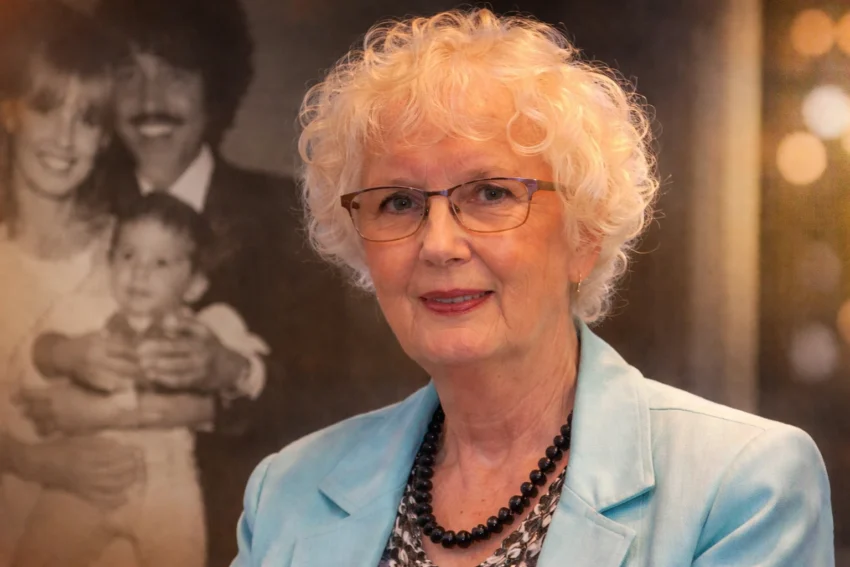
That moment tells you more about Caroline Crowther than most headlines ever could. She wasn’t just part of a famous man’s story. She was part of the reality behind it—the family life, the collapse, and the aftermath. And yet, despite her proximity to fame, she has spent decades doing something unusual in modern celebrity culture: stepping back, quietly and firmly, from public life.
Early Life and Family Background
Caroline Crowther was born into a world that already understood fame. She is the daughter of Leslie Crowther, a well-known British television presenter, comedian, and actor who became a household name in the UK through shows like The Price Is Right during the 1970s and 1980s. Growing up in that environment meant she saw firsthand how public attention worked, long before she became part of it herself.
Family life in the Crowther household wasn’t ordinary, but it also wasn’t chaotic in the way rock-and-roll families often are portrayed. Leslie Crowther was a polished entertainer, part of a generation that valued professionalism and public image. By all accounts, Caroline grew up in a stable environment shaped by media exposure but grounded in traditional British family values.
That early exposure to fame may explain something about her later choices. People who grow up around celebrity often understand both its appeal and its cost. Caroline Crowther didn’t chase the spotlight the way others might have. Instead, she moved toward a quieter path, even when circumstances later pushed her into public attention.
Details about her education remain largely private, which fits the broader pattern of her life. There are no widely reported schools or university affiliations, no early interviews discussing ambition or career dreams. What emerges instead is a portrait of someone who valued privacy from an early age, even when her surroundings suggested she could have chosen otherwise.
Entering the Music World
By the late 1970s, Caroline Crowther had entered the professional world, working for music publicist Tony Brainsby. This wasn’t a glamorous, front-facing role. Publicists operate behind the scenes, managing image, coordinating media, and smoothing the path between artists and the press. It’s work that requires discretion, emotional intelligence, and a steady hand.
That job placed her directly inside the orbit of the music industry at a time when British rock was at full throttle. Thin Lizzy, fronted by Phil Lynott, had already achieved major success. Songs like “The Boys Are Back in Town” had made them internationally recognizable, and Lynott himself had become a magnetic figure—part poet, part rebel, entirely compelling.
It was during this period that Caroline Crowther and Phil Lynott met. The exact details of their first meeting aren’t heavily documented, but the context matters. She wasn’t a fan encountering a star from a distance. She was working within the industry, understanding its rhythms and pressures, meeting Lynott as someone who already knew what fame could demand.
That difference shaped their relationship from the start. This wasn’t a story of innocence meeting chaos. It was two people meeting at a point where both understood, at least in part, the world they were stepping into together.
Marriage to Phil Lynott
Caroline Crowther and Phil Lynott married on February 14, 1980—Valentine’s Day, a detail that has always carried a certain poetic weight. By then, Lynott was at the height of his fame, and Thin Lizzy was one of the most prominent bands in the UK and Ireland.
Their relationship, however, had already begun to shape Lynott’s music. Their first daughter, Sarah, was born in 1978, before the marriage. Lynott wrote the song “Sarah” in her honor, and it became one of his most tender and personal recordings. Unlike his harder rock anthems, the song revealed a softer, deeply emotional side that fans hadn’t always seen.
Two years after their wedding, their second daughter, Cathleen, was born. By this point, Lynott’s public image included not just the rock star persona but also that of a husband and father. In interviews, he spoke about marriage bringing stability into his life, even describing himself as faithful and committed.
But here’s where the story becomes more complicated. Behind the scenes, the pressures of fame were taking their toll. Touring schedules, industry expectations, and personal struggles—particularly with substance use—began to erode the stability that marriage was supposed to bring.
By 1984, the marriage had broken down. Reports from biographers and music historians point to Lynott’s escalating drug use as a central factor. Anyone who has seen addiction unfold within a family knows how quickly it can change everything. What begins as a manageable problem can become overwhelming, affecting not just the individual but everyone around them.
For Caroline Crowther, this period marked a turning point. She was no longer simply the wife of a famous musician. She became someone navigating the fallout of a life that had drifted far from its earlier promise.
Motherhood and Family Life
If there is a constant thread in Caroline Crowther’s story, it is motherhood. Raising Sarah and Cathleen Lynott meant building a sense of normalcy in circumstances that were anything but normal. Their father was one of the most recognizable figures in rock music, and his life was increasingly unstable.
Music has a way of preserving moments, and in this case, it preserved their early years. “Sarah” remains one of Thin Lizzy’s most beloved songs, a permanent record of Lynott’s love for his daughter. Later accounts would describe both daughters as being immortalized in his work, a rare intersection of personal life and artistic legacy.
That legacy, however, comes with complexity. Growing up as the children of a famous musician means living with a version of your family that the public feels it knows. For Caroline Crowther, protecting her daughters’ privacy became a defining priority.
After Lynott’s death in 1986, she largely withdrew from public life, raising her children away from constant media attention. This decision stands out in an era where proximity to fame often leads to more exposure, not less. She chose the opposite path, focusing on her role as a mother rather than maintaining a public profile.
The Final Days of Phil Lynott
The end of Phil Lynott’s life is often described in dramatic terms, but the reality is quieter and more painful. On December 25, 1985, he collapsed at home after years of substance abuse had taken a severe toll on his health.
Caroline Crowther was no longer living with him at that point, but she was still connected to him through their shared history and their children. When she learned of his condition, she drove from Bath to help him, playing a crucial role in getting him medical attention.
He was eventually admitted to Salisbury Infirmary, where he died on January 4, 1986, at the age of 36. The circumstances were stark, stripped of any romanticism. A young man, once full of energy and talent, was gone, leaving behind a family forced to navigate grief in the public eye.
For Caroline Crowther, this moment closed one chapter of her life and began another. She was now the former wife of a rock legend, the mother of his children, and someone who had to decide how much of that story she would continue to share with the world.
Life After Loss
What happened after Lynott’s death is where Caroline Crowther’s story becomes both quieter and more revealing. She chose to step away from public life, a decision that has shaped how she is remembered.
There were tensions within the family, particularly between Crowther and Lynott’s mother, Philomena. Public records indicate that Philomena later sought legal action to secure access to her grandchildren. The details of that conflict remain largely private, and both sides of the story are not fully documented in public sources.
That said, the existence of the dispute highlights a broader truth about families dealing with loss, especially when that loss is tied to fame. Grief doesn’t unfold neatly, and when a public figure is involved, questions of legacy, memory, and access can become deeply complicated.
Through it all, Caroline Crowther maintained her distance from media attention. She did not publish memoirs or give frequent interviews. Instead, she appeared only occasionally in connection with projects related to Lynott’s life, including contributing reflections to authorized biographies.
One such contribution described Lynott as “a mass of contradictions,” a phrase that captures both affection and honesty. It suggests a perspective shaped not by myth but by lived experience.
Financial Standing and Net Worth in 2026
Estimating Caroline Crowther’s financial position is difficult due to her private lifestyle. There are no confirmed public disclosures of her income, assets, or business ventures. However, estimates typically place her net worth between $1 million and $2 million as of 2026, though these figures should be treated cautiously.
Her financial standing is likely tied to a combination of personal assets, potential settlements following her marriage, and any arrangements connected to Lynott’s estate. It’s also possible that her background and early career provided additional financial stability, though details remain limited.
Unlike many individuals connected to high-profile figures, Crowther did not build a public brand or commercial enterprise around her association with Lynott. That choice likely influenced her financial trajectory, favoring privacy over visibility.
Lesser-Known Details About Caroline Crowther
Not many people know this, but Caroline Crowther’s connection to the music industry began before her relationship with Lynott. Working with Tony Brainsby placed her at the center of British music publicity during a crucial period, giving her insight into how artists were presented to the world.
Another detail that often gets overlooked is her contribution to Lynott’s legacy through selective participation in biographical projects. She has not been completely absent from the record, but her involvement has been measured and purposeful, adding depth without seeking attention.
What’s surprising is how consistently she has maintained her privacy over decades. In an age where information spreads quickly and often without verification, Crowther has managed to keep much of her personal life out of public view. That level of discretion is rare, especially for someone so closely linked to a major cultural figure.
There is also the simple fact that her story intersects with two different eras of British entertainment. Through her father, she is connected to traditional television culture. Through Lynott, she is part of rock history. Few people occupy both spaces in such a direct way.
Where Caroline Crowther Is Now
As of 2026, Caroline Crowther remains largely out of the public eye. There are no confirmed recent interviews, public appearances, or major projects associated with her. Most reliable sources agree on one point: she has chosen a private life and has maintained that choice consistently.
Her daughters, however, have occasionally engaged with projects related to their father’s legacy. Documentary films and retrospectives have included their perspectives, offering glimpses into the family’s story without fully opening it up.
That balance reflects a broader approach to legacy. The family has allowed aspects of Lynott’s life to be explored while keeping their own lives protected. Caroline Crowther’s role in that balance appears to have been central, even if it is rarely discussed directly.
Frequently Asked Questions
Who is Caroline Crowther?
Caroline Crowther is a British private individual best known as the former wife of Thin Lizzy frontman Phil Lynott and the daughter of TV presenter Leslie Crowther. She is also the mother of Lynott’s two daughters, Sarah and Cathleen. Her public recognition comes largely from these connections rather than a separate media career.
When did Caroline Crowther marry Phil Lynott?
She married Phil Lynott on February 14, 1980. Their relationship had already begun earlier, as they had their first daughter in 1978. The marriage lasted until 1984, when it ended amid growing personal challenges.
How many children does Caroline Crowther have?
Caroline Crowther has two children, Sarah Lynott and Cathleen Lynott. Both daughters were born during her relationship with Phil Lynott and have been referenced in his music and legacy. They have occasionally participated in projects about their father’s life.
Is Caroline Crowther still alive?
Yes, based on available public information, Caroline Crowther is still alive as of 2026. She maintains a private life, which is why there are limited recent updates about her. This lack of visibility often leads to speculation, but reliable sources confirm her continued privacy rather than absence.
What is Caroline Crowther doing now?
She appears to be living a private life away from media attention. There are no confirmed professional activities or public engagements in recent years. Her focus seems to have remained on personal and family matters rather than public work.
Conclusion
Caroline Crowther’s life doesn’t follow the usual arc of someone connected to fame. She entered the public eye through family and marriage, experienced its intensity during one of rock’s most volatile eras, and then chose to step away. That choice defines her as much as any headline ever could.
Her story is closely tied to Phil Lynott’s, but it isn’t limited to it. She represents the human side of a narrative that often gets simplified into legend. Behind the music, behind the mythology, there were relationships, responsibilities, and difficult decisions that shaped real lives.
There is also something quietly powerful in her refusal to turn that history into ongoing public content. In a world that often rewards visibility, Caroline Crowther’s life stands as an example of restraint. She has allowed the parts of her story that matter most—family, memory, and personal experience—to remain largely her own.
If you came looking for a dramatic reveal or a hidden chapter, you won’t find it here. What you will find is a life that intersects with fame but isn’t defined by it. And in many ways, that makes Caroline Crowther more interesting than most stories that stay in the spotlight.