
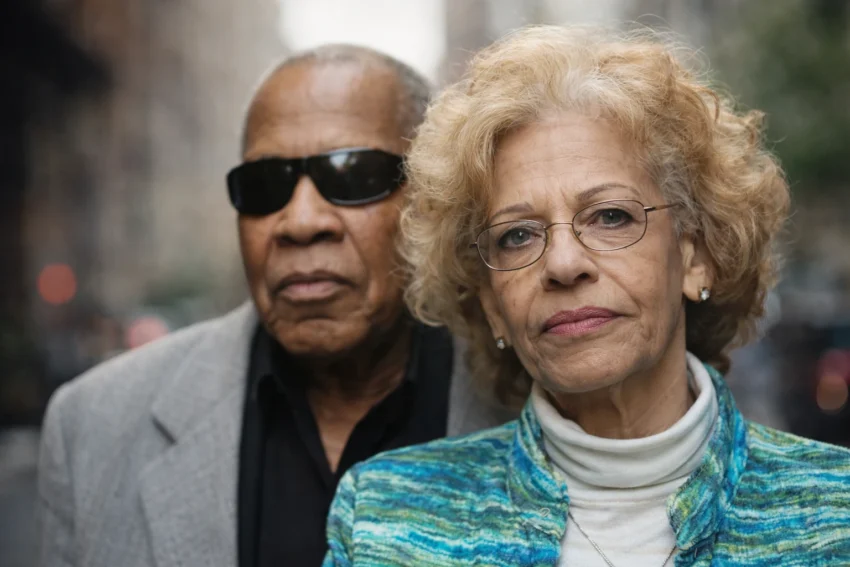
Frank Lucas built a reputation as one of the most infamous drug traffickers in American history, a man whose story would later be dramatized in American Gangster. But behind the headlines, the courtroom battles, and the mythology that grew around him, there was a quieter figure whose life has remained far less understood: his wife, Julie Farrait.
For many people, she exists only as a supporting character in Lucas’s story—a glamorous partner glimpsed in photographs or portrayed on screen. The truth is more complicated. Julie Farrait was not just a bystander to one of the most notorious criminal enterprises of the 20th century. She was part of its orbit in ways that shaped her own life, her family, and the legacy that still follows the Lucas name.
Early Life and Background
Julie Farrait, sometimes referred to as Julianna Farrait, is widely described in public records as a Puerto Rican woman, though detailed documentation about her early life remains limited. Like many figures connected to organized crime, especially women, her story before public attention is often reduced to fragments rather than a fully documented narrative. There is no widely verified account of her upbringing, education, or early ambitions.
What is known comes largely from secondary reporting and Frank Lucas’s own recollections. These accounts suggest she spent part of her early life in Puerto Rico before eventually crossing paths with Lucas during his travels. The lack of detailed records is not unusual, particularly for individuals who did not seek public attention before becoming linked to a high-profile figure.
That absence of early documentation has contributed to myths and exaggerations. Some retellings have described her as a beauty queen or a Miss Puerto Rico titleholder, but fact-checking of these claims has found no official record supporting that status. Even Lucas himself offered a more modest description, suggesting she may have been a local pageant or homecoming figure rather than a national titleholder.
Meeting Frank Lucas
The most commonly cited version of how Julie Farrait met Frank Lucas comes from Lucas’s own memoir, Original Gangster, and later retellings. According to that account, they met on a flight from Puerto Rico to New York sometime in the 1960s. Whether every detail of that story is precise is difficult to confirm, but it has become the standard narrative repeated across sources.
Their relationship developed during a period when Lucas was expanding his influence in Harlem. By the late 1960s, he was building what would become a highly lucrative heroin operation, importing drugs and distributing them through a network that would later draw the attention of federal investigators. Farrait entered his life at a time when his power and wealth were rising quickly.
They married around 1967, according to widely cited accounts, though the exact date is not consistently documented in public records. From that point forward, Farrait became part of Lucas’s inner circle, living a life that combined luxury with increasing exposure to legal risk.
Life at the Height of Lucas’s Power
During the early 1970s, Frank Lucas was at the peak of his influence, and Julie Farrait was part of the lifestyle that came with it. Accounts from the period describe a world of expensive clothing, high-profile appearances, and access to large sums of cash. Farrait’s public image, to the extent that it existed, was tied closely to this environment of visible wealth.
One of the most famous moments associated with her involves the heavyweight boxing match between Muhammad Ali and Joe Frazier in March 1971. According to widely reported accounts, Farrait purchased a lavish chinchilla coat and hat for Lucas, which he wore to the fight. The outfit drew attention not only because of its cost but because it signaled a level of wealth that stood out even among celebrities.
That moment has often been framed as a turning point, but the reality is more complicated. Law enforcement officials were already aware of Lucas and his operations. The coat did not create suspicion out of nothing, but it did make him more visible in a setting where attention mattered.
Farrait’s role during this period is difficult to define with precision. Some accounts portray her as primarily a spouse enjoying the benefits of Lucas’s success, while others suggest she was more directly aware of, and possibly involved in, aspects of his business. The truth likely sits somewhere in between, though the available evidence does not allow for a definitive conclusion on the extent of her involvement during these early years.
Legal Trouble and Arrests
The collapse of Frank Lucas’s empire in the mid-1970s brought Julie Farrait into direct contact with the legal system. When authorities moved against Lucas, they also targeted his family and associates. During a raid on their home in Teaneck, New Jersey, Farrait was reportedly present, and accounts describe her attempting to handle large amounts of cash as law enforcement closed in.
She was arrested as part of the broader investigation, and like Lucas, she faced serious charges. However, the exact details of her sentencing during that period are not consistently reported across sources, which makes it difficult to reconstruct a precise timeline of her early legal consequences. What is clear is that prison became part of her life, not just her husband’s.
Their daughter, Francine Lucas, has spoken publicly about this period, offering one of the most reliable perspectives on its impact. She has described growing up with both parents incarcerated at different times, often being raised by relatives rather than within a stable household. These accounts provide a grounded counterpoint to the more glamorous portrayals of the Lucas lifestyle.
Family Life and Children
Julie Farrait and Frank Lucas had children together, though the number and identities of all their children are not consistently documented in public sources. The most well-known is their daughter, Francine Lucas, who has spoken openly about her upbringing and later became involved in advocacy work for children of incarcerated parents.
Francine’s experiences highlight the personal cost of the choices made by her parents. She has described feelings of isolation, instability, and the challenge of navigating a childhood shaped by imprisonment and public notoriety. Her later work, including founding the organization Yellow Brick Roads, reflects an effort to address those challenges for others.
Family life for Farrait was marked by long periods of separation due to legal troubles, followed by time spent in witness protection after Frank Lucas agreed to cooperate with authorities. That phase of their lives required a significant shift, moving from public displays of wealth to relative anonymity and caution.
The emotional and practical demands of that transition are not well documented, but it is reasonable to assume they were considerable. Witness protection often involves relocation, identity changes, and strict limitations on contact with former associates, all of which can place strain on family relationships.
Later Legal Issues
Julie Farrait’s legal troubles did not end with the fall of Frank Lucas’s empire. Decades later, her name reappeared in news reports connected to another drug-related case. In 2010, she was arrested in Puerto Rico as part of an operation involving the alleged sale of cocaine.
Authorities reported that she had been under investigation prior to the arrest, and the case drew attention because of her connection to Lucas. By that time, Lucas himself was elderly and no longer active in the world that had made him infamous, but Farrait’s arrest suggested that elements of that past had not entirely faded.
In 2012, she was sentenced in federal court in Manhattan, with reports indicating a five-year prison term. This later case complicates any attempt to portray her as merely a figure shaped by her husband’s actions. It suggests a level of personal agency and involvement that continued well beyond the original era of Lucas’s criminal activity.
Public Image and Cultural Portrayal
Julie Farrait’s public image has been shaped less by direct interviews or personal statements and more by how others have told her story. The most influential portrayal remains the character Eva in American Gangster, played by Lymari Nadal. That version emphasizes loyalty, elegance, and emotional connection, presenting a simplified narrative designed for a wide audience.
While the film brought renewed attention to Lucas and his life, it also blurred the line between fact and fiction. Farrait’s real-life experiences were compressed into a storyline that prioritized drama and coherence over accuracy. Important elements, including the full scope of family challenges and later legal issues, were either minimized or omitted entirely.
Outside of the film, Farrait has largely avoided public attention. There are no widely known interviews in which she offers her own perspective on her life, which means her story is often told through the lens of others. This absence has contributed to the persistence of myths and the difficulty of separating confirmed facts from speculation.
Financial Life and Net Worth
Estimating Julie Farrait’s personal net worth is difficult, and any figures circulating online should be treated with caution. During the height of Frank Lucas’s operation, the couple had access to substantial wealth, though much of it was tied to illegal activity and subject to seizure by authorities.
After Lucas’s arrest and cooperation with law enforcement, significant portions of his assets were confiscated. The family’s move into witness protection and later years did not reflect the same level of financial excess that had characterized their earlier life.
There are no reliable, publicly verified estimates of Farrait’s individual net worth. Any modern financial status would likely reflect a mix of residual resources, family support, and the long-term consequences of legal issues rather than the dramatic wealth associated with Lucas’s peak years.
Later Years and Current Status
One of the most frequently asked questions about Julie Farrait concerns her current status. The answer is not entirely clear, and this is one area where sources conflict. Some reports have suggested that she died before Frank Lucas, who passed away in 2019. Other accounts claim she survived him and has lived privately, away from public attention.
The lack of a definitive, widely confirmed record makes it difficult to state her current status with certainty. This uncertainty reflects the broader challenge of reporting on individuals who have spent long periods outside the public eye, especially after involvement in high-profile legal cases.
What is clear is that Farrait has not sought public visibility in recent years. Whether alive or deceased, she remains a figure defined largely by past events rather than ongoing public activity.
Legacy and Public Interest
Julie Farrait’s legacy is tied closely to the story of Frank Lucas, but it is not limited to it. Her life illustrates how the impact of organized crime extends beyond the central figure to include spouses, children, and extended families. It also highlights the difficulty of reconstructing accurate biographies when much of the available information comes from partial or secondhand accounts.
Public interest in her story continues because it sits at the intersection of crime history, film, and human curiosity. Readers want to understand not just what happened, but how it felt to live inside such a world. Farrait’s story offers glimpses of that experience, even if many details remain out of reach.
Her daughter’s public work has also contributed to this legacy, shifting the focus from notoriety to resilience. That dimension adds depth to a narrative that might otherwise be reduced to crime and punishment alone.
Frequently Asked Questions
Who was Frank Lucas’s wife?
Frank Lucas’s wife was Julie Farrait, also known as Julianna Farrait. She was a Puerto Rican woman who became publicly known through her marriage to Lucas and her connection to his criminal enterprise.
Was Julie Farrait portrayed in American Gangster?
Yes, she was portrayed as the character Eva in the 2007 film American Gangster, played by actress Lymari Nadal. The film’s version is fictionalized and does not fully reflect her real-life experiences.
Did Julie Farrait go to prison?
Yes, she was involved in legal cases connected to drug-related activities and served time in prison. She was also sentenced in 2012 following a cocaine-related case.
Did Julie Farrait and Frank Lucas have children?
They had children together, including their daughter Francine Lucas. Francine has spoken publicly about her upbringing and later became an advocate for children with incarcerated parents.
Is Julie Farrait still alive?
There is no fully confirmed, consistent public record about her current status. Some reports suggest she died before Frank Lucas, while others indicate she may still be alive but living privately.
What was Julie Farrait’s role in Frank Lucas’s operations?
Her exact role remains unclear. While she was closely connected to Lucas and benefited from his wealth, the extent of her direct involvement in his criminal activities is not definitively documented.
Conclusion
Julie Farrait’s life resists easy categorization. She has been described as a loyal wife, a participant in crime, a mother navigating upheaval, and a figure shaped by circumstances beyond her control. Each of these descriptions contains some truth, but none fully captures the complexity of her experience.
What stands out is how little of her own voice is present in the public record. Her story is often told through others—through law enforcement reports, family accounts, and a Hollywood film that prioritized narrative over detail. That absence leaves room for both curiosity and caution.
Her life also underscores the long shadow cast by crime, extending far beyond the individual at its center. The consequences of Frank Lucas’s actions touched every part of his family, including Farrait, in ways that cannot be reduced to headlines or movie scenes.
For readers trying to understand who she was, the most honest answer is also the simplest. Julie Farrait was a real person living inside a complicated and often damaging world, one whose full story may never be completely known but whose impact is still felt through the lives connected to hers.