
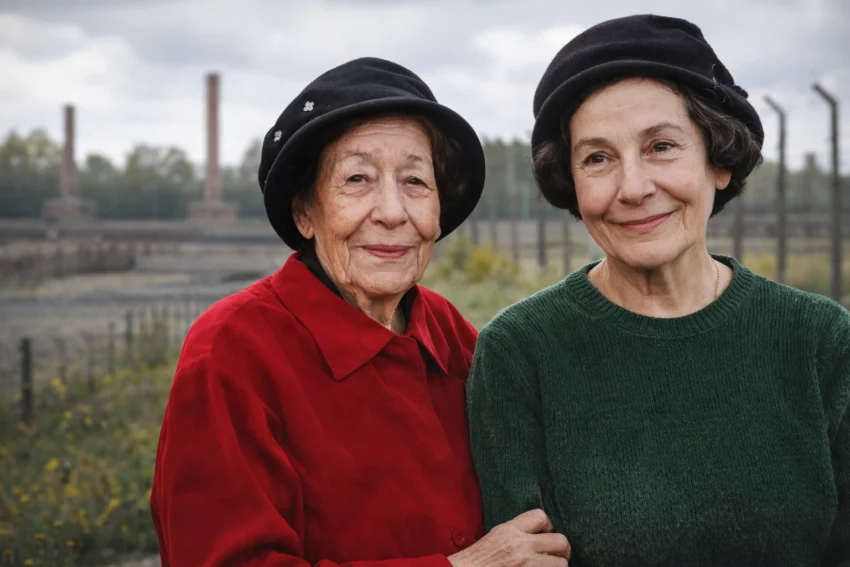
The name Gabi Goslar often surfaces in conversations connected to Anne Frank and the Holocaust, yet it is frequently misunderstood. In many online searches and informal accounts, details blur between family members, and identities become tangled. To understand who Gabi Goslar truly was, one must step carefully through documented history, separating verified facts from assumptions that have circulated over time.
Gabi Goslar was not a public diarist, nor did she become an internationally known speaker like her older sister. Instead, her life story unfolds quietly within one of the darkest chapters of the twentieth century. She was a child born into war, deported into the Nazi camp system, and one of the few who survived its final chaos. Her biography is not one of celebrity, but of survival, family bonds, and historical memory.
Early Life in Wartime Amsterdam
Gabi Goslar was born Rachel Gabriela Ida Goslar in Amsterdam in October 1940. Her birth came only months after Nazi Germany invaded the Netherlands in May of that year. By the time she entered the world, Dutch society was already being reshaped under occupation.
Her family had fled Germany earlier to escape the rise of Adolf Hitler and growing antisemitism. Like many German-Jewish families, the Goslars sought safety in neighboring countries, believing the Netherlands would provide refuge. For a brief period, it did.
Gabi’s older sister, Hannah Pick-Goslar, attended school with Anne Frank in Amsterdam. Hannah and Anne were close childhood friends before the Frank family went into hiding in 1942. At that time, Gabi was still a toddler. She was too young to share in the schoolyard memories that later became famous through Anne Frank’s diary.
Nevertheless, Gabi’s early childhood unfolded within the same tightening net of anti-Jewish measures. Jewish families were barred from public spaces. Children were forced into segregated schools. Businesses were confiscated. Deportations began in 1942. Although she was too young to understand the politics, Gabi’s life was already shaped by them.
Arrest and Deportation
In June 1943, the Goslar family was arrested by the occupying authorities. Like thousands of Jewish families in the Netherlands, they were sent to Westerbork transit camp. Westerbork functioned as a staging ground for deportations to concentration and extermination camps further east.
Life in Westerbork was marked by uncertainty and fear. Transports departed regularly, and names were called from lists that determined who would leave next. Families waited, never knowing whether the next train meant forced labor or death.
Gabi, barely three years old, experienced this period entirely dependent on her older sister and father. Historical accounts emphasize Hannah’s role as caregiver. Even as a young teenager, Hannah took on responsibility for protecting her little sister, providing comfort and trying to maintain some sense of stability in an unstable world.
Later that year, the Goslar family was deported again, this time to Bergen-Belsen concentration camp in Germany. The move marked a severe escalation in their suffering.
Bergen-Belsen and the Harsh Reality of Camp Life
Bergen-Belsen was not originally built as an extermination camp, but conditions deteriorated drastically as the war progressed. Overcrowding, starvation, disease, and lack of sanitation led to mass death, particularly in the final months of the war.
It was here that Hannah Pick-Goslar briefly reunited with Anne Frank. The two girls, separated since 1942, discovered they were held in different sections of the camp. Through a fence barrier, they managed to speak and exchange small packages of food over several nights.
Gabi, however, was not part of those encounters. She was still a small child, weakened by malnutrition and illness like so many prisoners. Yet her presence shaped Hannah’s determination. Survivor testimonies repeatedly highlight that Hannah’s sense of responsibility toward her younger sister strengthened her will to survive. Protecting Gabi gave her purpose in a place designed to strip people of hope.
Bergen-Belsen grew increasingly chaotic in early 1945 as Allied forces advanced. Disease spread rapidly. Thousands died from typhus, including Anne Frank and her sister Margot shortly before liberation. The camp became a symbol of the brutality and collapse of the Nazi regime.
Against overwhelming odds, both Hannah and Gabi survived.
The “Lost Train” and Liberation
In April 1945, as the Third Reich neared defeat, some Bergen-Belsen prisoners were placed on evacuation transports. One of these transports became known as the “Lost Train.” Intended to move prisoners to Theresienstadt, the train wandered across war-torn Germany due to destroyed tracks and collapsing command structures.
Conditions on the train were dire. Prisoners endured hunger, dehydration, and continued fear. Yet paradoxically, this chaotic evacuation ultimately contributed to survival for some. The train was eventually liberated by advancing Soviet forces.
Hannah and Gabi were among the survivors.
Liberation did not immediately mean recovery. Survivors faced physical weakness, grief, and the overwhelming task of rebuilding life after trauma. For Gabi, who had spent much of her early childhood in camps, normalcy was something she had never fully known.
Postwar Life and Privacy
After the war, the Goslar sisters returned to the Netherlands. Their father had also survived, though other family members did not. Like many Jewish survivors, the family confronted loss on a scale that was difficult to articulate.
Hannah Pick-Goslar eventually emigrated to what would become Israel, married, raised children, and later became an educator and public speaker. She dedicated much of her later life to sharing her experiences and preserving the memory of Anne Frank and the Holocaust.
Gabi’s path, however, remained far more private.
Public records and reputable sources provide limited detail about her later life. Unlike her sister, she did not become a prominent public figure or memoirist. This relative silence has often led to confusion, speculation, or even fabricated online biographies.
In truth, many Holocaust survivors chose not to live publicly in relation to their trauma. Rebuilding a life often meant focusing on family, work, and community rather than public storytelling. Gabi Goslar appears to have followed this quieter route.
Respecting that privacy is essential. Biography should illuminate, not invent.
The Relationship to Anne Frank
Much of the curiosity surrounding Gabi Goslar stems from her indirect connection to Anne Frank. Because Hannah Pick-Goslar was one of Anne’s closest childhood friends, searches about the Frank family often lead to the Goslar family.
However, it is important to clarify that Gabi herself was not Anne Frank’s school friend. She was significantly younger and did not share those early classroom experiences.
The emotional weight of the story often lies in the image of Hannah at the fence in Bergen-Belsen, calling out to Anne and attempting to pass food across the barrier. That moment has become one of the most poignant post-diary accounts of Anne Frank’s final weeks.
Gabi’s role in that history is quieter but no less significant. She was the child Hannah returned to each night, the sibling whose survival shaped Hannah’s choices, and the family member who endured the same suffering. Through her, we see the broader truth that Anne Frank’s story was not isolated. It unfolded within a network of families facing similar persecution.
Historical Context and the Importance of Accuracy
The Holocaust resulted in the murder of six million Jewish people, alongside millions of other victims targeted by Nazi persecution. Institutions such as the United States Holocaust Memorial Museum and the Arolsen Archives have spent decades documenting records, transport lists, and personal testimonies to preserve factual history.
In the digital age, however, misinformation spreads quickly. When a name like “Gabi Goslar” trends online, articles sometimes appear that conflate identities or invent details to attract clicks. These inaccuracies may seem minor, but they distort the historical record.
Biography writing carries responsibility. Every correction helps maintain clarity about who endured these events and how they survived. For survivors and their descendants, accuracy is a form of respect.
The Broader Meaning of Survival
Gabi Goslar’s life reminds us that survival stories are often complex and understated. Not every survivor wrote a diary. Not every survivor became a public witness. Many lived long lives outside headlines, carrying memory quietly.
The narrative of the Holocaust often centers on iconic figures because they provide accessible entry points into a vast tragedy. Yet the full history consists of countless individual lives, each shaped by loss, resilience, and reconstruction.
In that sense, Gabi Goslar represents the majority rather than the exception. She stands for the children who were too young to record their experiences but old enough to suffer them. Her story reflects siblings bound together in extreme conditions and symbolizes the enduring strength of family ties in the face of systematic cruelty.
Legacy and Memory
Today, discussions about Holocaust memory remain deeply relevant. Surveys have shown that knowledge about the Holocaust varies widely across generations. At the same time, incidents of antisemitism have increased in several countries in recent years.
Accurate biographies contribute to collective memory. They help anchor discussions in documented truth rather than myth. Even a seemingly small clarification—understanding who Gabi Goslar was and how she differed from her sister—strengthens that foundation.
Memory is not static. It evolves with each generation. But its credibility depends on careful storytelling.
Conclusion
Gabi Goslar’s biography does not follow a dramatic arc of public fame. Instead, it unfolds as a testament to survival within one of history’s most devastating systems of persecution. Born into occupied Amsterdam, deported as a small child, imprisoned in Bergen-Belsen, and ultimately liberated during the war’s chaotic final days, she lived through events that reshaped the world.
Her story intersects with that of Anne Frank through her sister Hannah, yet it stands on its own. It is the story of a child protected by family, of endurance under unimaginable hardship, and of a life that continued beyond the camps.
In a world where names can be easily misrepresented or oversimplified, telling Gabi Goslar’s story with care matters. Biography is not just about recognition. It is about preservation. Through accuracy, respect, and historical context, we ensure that even quieter lives remain part of the enduring record of human resilience.
Gabi Goslar may not have written a diary, but her survival is part of the same history. And remembering that history faithfully remains one of the most important responsibilities we share.