
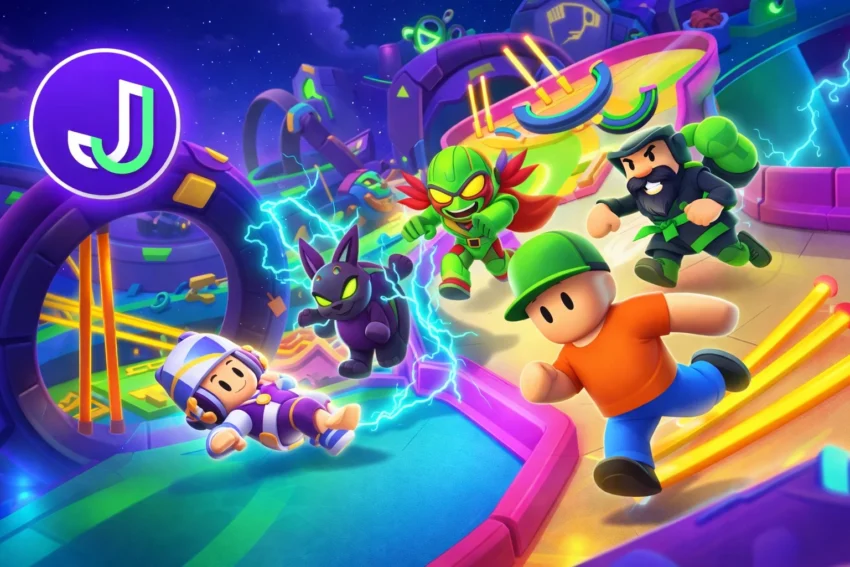
In the fast-moving world of mobile gaming, trends come and go almost overnight. Yet every so often, a particular search term begins to surface repeatedly, revealing more than just curiosity. “Jojoy Stumble Guys” is one of those phrases. At first glance, it looks like a simple combination of a third-party app platform and a wildly popular multiplayer game. But behind that pairing lies a deeper story—one that touches on digital culture, gaming ambition, online risk, and the psychology of shortcuts.
This is not just about downloading a modified game. It is about why players search for alternatives in the first place. It is about the tension between access and integrity, between convenience and consequence. To understand “jojoy stumble guys,” you have to understand the evolution of mobile gaming itself, and the people who navigate it every day.
The Rise of Stumble Guys
From Casual Chaos to Global Phenomenon
When Stumble Guys launched, it entered a market already crowded with battle royale titles and competitive multiplayer games. However, it carved its own niche through simplicity. Bright colors, playful physics, and chaotic obstacle courses made it instantly accessible. Players did not need hours of practice to enjoy it. They simply had to jump in and survive.
The game’s appeal spread quickly. Streamers showcased hilarious fails. Friends challenged each other in private rooms. Younger audiences found it approachable, while older players appreciated its lighthearted nature. Over time, Stumble Guys became more than a casual pastime. It turned into a social arena where identity was expressed through skins, emotes, and limited-edition cosmetics.
The Economy of Free-to-Play
Like most successful mobile titles, Stumble Guys operates on a free-to-play model. The game itself costs nothing to download, but it generates revenue through in-app purchases. Gems, tokens, special passes, and cosmetic upgrades create a layered progression system.
For many players, this structure feels fair. You can enjoy the core experience without spending a cent. Yet there is also an undeniable pull toward premium content. Rare skins stand out in crowded lobbies. Exclusive emotes signal dedication or status. Over time, the desire to unlock more becomes part of the journey.
It is in that environment that alternative download sources begin to attract attention.
Understanding Jojoy
A Third-Party Gateway
Jojoy is widely recognized as a third-party app distribution platform. It offers downloadable versions of various mobile games and applications, often including modified builds that promise unlocked features or enhanced functionality.
For some users, Jojoy represents convenience. For others, it represents opportunity. The idea of accessing premium content without spending money can feel irresistible. In online forums and social media threads, the name frequently appears alongside games with strong cosmetic economies, including Stumble Guys.
The pairing of “jojoy stumble guys” typically signals interest in a modified version of the game—one that claims to remove restrictions, unlock skins, or provide unlimited resources.
The Appeal of Modification
The appeal is not purely financial. It is psychological. Players may feel stuck in progression. They may see others advancing faster. They may believe that cosmetic access levels the playing field socially, even if it does not change gameplay mechanics.
There is also the thrill of bypassing systems. In digital spaces, rule-bending can feel like empowerment. The promise of instant access satisfies impatience in a world already conditioned by fast results.
However, shortcuts rarely exist without trade-offs.
Risks Beneath the Surface
Security in a Changing Android Landscape
The Android ecosystem has evolved significantly over the past few years. Security layers have become more sophisticated. Google Play Protect scans billions of applications daily and identifies potentially harmful software across devices worldwide.
Third-party app installations fall outside the strict review processes of official stores. While not every external download is malicious, the statistical likelihood of encountering harmful software increases when apps bypass official verification channels.
Malware disguised as legitimate applications has grown more sophisticated. Some versions quietly harvest login credentials. Others flood devices with intrusive advertising or redirect users to unsafe websites. In severe cases, malicious apps attempt to gain administrative control of devices.
The danger is rarely visible at installation. It often emerges gradually.
Account Integrity and Fair Play
Beyond device-level risks, there is also the issue of account enforcement. Game publishers invest heavily in anti-cheat systems. Even if a modified build functions temporarily, it can trigger automated detection mechanisms.
Players risk warnings, suspensions, or permanent account bans. For someone who has spent months progressing or purchasing items legitimately, that loss can be devastating.
Moreover, the integrity of multiplayer environments depends on fairness. When modified versions circulate widely, developers may respond with stricter monitoring, which affects the entire community.
The Ethical Dimension
Funding the Experience
Mobile games do not operate in isolation. Behind Stumble Guys is a team of designers, developers, artists, and community managers. Servers require maintenance. New seasons demand creative investment. Cosmetic items, though optional, help fund that ecosystem.
Using modified builds that unlock premium content without payment disrupts that economic model. While one download may seem insignificant, large-scale circumvention can influence monetization strategies, potentially leading to more aggressive paywalls or restrictive policies.
Community Impact
Games thrive when communities trust the environment. If players believe others are bypassing systems unfairly, frustration grows. Competitive balance erodes. Developers tighten restrictions, sometimes at the cost of player freedom.
In this sense, the choice to download modified software becomes more than a personal decision. It becomes a community decision.
Why the Search Continues
Despite known risks, the search term “jojoy stumble guys” persists. That persistence reveals a gap between player expectations and game economics.
Some players feel monetization moves too quickly. Others believe cosmetic pricing is excessive. Many simply want to experiment. In an era defined by digital abundance, waiting can feel outdated.
The broader technology culture reinforces this mindset. We are accustomed to immediate streaming, instant downloads, and rapid updates. When progress slows, frustration rises.
Understanding this context helps explain why alternative app sources gain attention, even as official platforms strengthen safeguards.
Safer Paths to Progress
Strategic Gameplay Over Shortcuts
Ironically, many players seeking unlocked features would benefit more from strategic improvement than cosmetic access. Consistency in obstacle timing, awareness of crowd movement, and patience during final rounds significantly increase win rates.
As performance improves, in-game rewards accumulate naturally. Progress becomes tied to skill rather than modification.
Mindful Spending and Patience
Free-to-play economies reward patience. Saving currency for meaningful purchases rather than impulsive spins can transform the experience. Players who adopt a long-term mindset often feel more satisfied with their unlocks.
Official seasonal events frequently offer bonus rewards. Staying engaged during these periods provides value without compromising security.
The Broader Lesson
The story of “jojoy stumble guys” mirrors a larger digital narrative. Technology gives us endless possibilities, but it also demands discernment. Not every accessible path is advisable. Not every shortcut saves time in the long run.
Mobile gaming is no longer a fringe hobby. It is a billion-dollar industry intertwined with cybersecurity, digital identity, and global culture. As platforms grow, so do the complexities around them.
The search term represents more than a modded APK. It represents modern impatience, ambition, and the desire to stand out.
Conclusion
At its core, “jojoy stumble guys” is a reflection of how players interact with digital ecosystems. It captures the tension between access and accountability, between desire and discretion.
Stumble Guys thrives because it offers lighthearted competition and social connection. That experience depends on stable infrastructure and fair play. While third-party platforms may promise quick rewards, they often introduce risks that outweigh the benefits.
The wiser path is rarely the flashiest. Downloading games through official channels, improving skills organically, and respecting community guidelines may not unlock everything instantly. However, they preserve what matters most: security, continuity, and trust.
In the end, the true victory in any multiplayer game is not just crossing the finish line first. It is knowing that your progress is real, your account is safe, and your experience remains intact for the matches yet to come.