
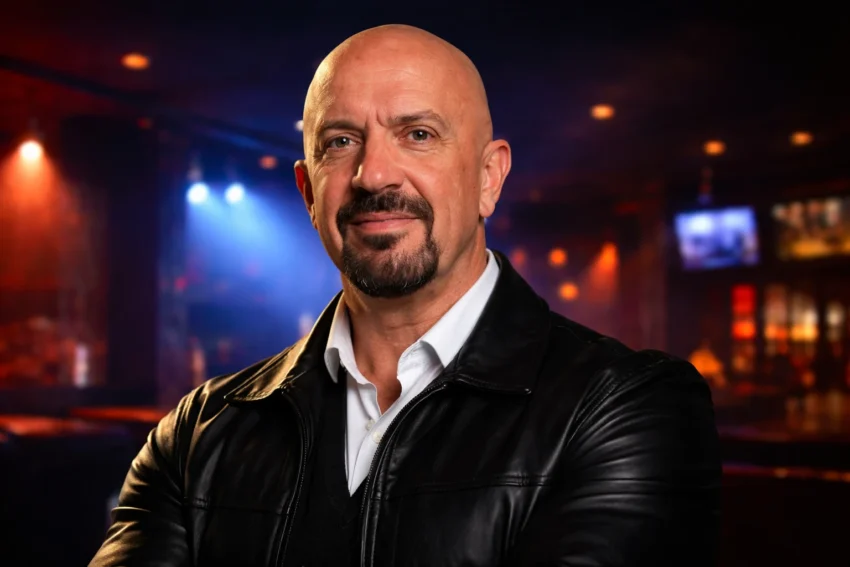
Marcus Redwood’s name tends to surface in a very specific corner of British culture. It shows up in late-night podcast conversations, in YouTube interviews with former security men, and on the back cover of a memoir that promises stories from a harder, rougher version of the country’s nightlife. For some readers, he’s a familiar figure tied to decades of door work and private security. For others, he’s a name they’ve only just encountered and want to place.
But here’s the thing: Redwood’s public story exists in two layers. There’s the record that can be checked—company filings, a published book, local reporting—and then there’s the legend that has grown around him through interviews and self-told accounts. Any attempt to understand his life has to sit somewhere between those two.
Early Life and Background
Marcus Joseph Redwood was born in October 1962 in the United Kingdom, coming of age during a period when British nightlife was both expanding and, at times, chaotic. Public records do not offer a detailed portrait of his childhood or schooling, and Redwood himself has kept much of his early life outside formal documentation. That absence of detail is not unusual for figures who later emerge from working-class or trade-based careers rather than traditional professional paths.
What is clearer is the era he grew up in. The 1970s and early 1980s saw British towns and cities develop dense networks of pubs and nightclubs, often with little formal regulation of door staff. Young men entering that world learned quickly, and reputations spread by word of mouth. Redwood’s later accounts suggest he entered that environment relatively young, building a name in a setting where physical presence and quick judgment were part of the job.
Not many people know this, but the culture of doormen in that period was not yet a regulated profession. Licensing requirements and structured training came much later. That context matters because it shaped the kind of career Redwood would later describe—a mix of informal authority, personal reputation, and survival in unpredictable environments.
Entering the World of Door Security
Redwood’s early working years are most closely associated with nightclub and pub security, commonly referred to as “door work.” By his own account, this was where his reputation began to form, though independent documentation of specific venues or timelines is limited. The truth is, much of what is known about this phase comes from Redwood’s later retelling in interviews and his memoir.
That said, the broader pattern aligns with how many in the trade operated. Door staff often worked across multiple venues, building contacts and gaining experience in managing crowds, de-escalating conflicts, and, at times, handling violence. Redwood’s public persona leans heavily on this period, presenting it as both formative and defining.
Here’s where it gets interesting. The image of the British doorman—part enforcer, part mediator—has long been tied to stories of toughness and confrontation. Redwood’s narrative fits squarely into that tradition, describing a career shaped by frequent altercations and high-pressure situations. Whether every detail can be independently verified is another matter, but the framework itself reflects a real and documented slice of nightlife history.
Building a Career in Private Security
As the security industry began to professionalize in the late 1990s and early 2000s, many experienced doormen moved into more formal roles. Redwood appears to have followed a similar path, transitioning from individual door work into broader security operations. His name is associated with Marc-One Security, a company described as providing services across events, venues, and private clients.
According to company descriptions, Marc-One Security traces its origins back to around 1990, though formal corporate records show more recent company structures under similar names. That difference is not unusual in small business histories, where a brand or working operation can exist long before or separate from a specific registered entity. Still, it highlights a recurring theme in Redwood’s story: the gap between narrative continuity and documented timelines.
Public filings link Redwood to several security-related companies, including roles in Pro-Tech Security (UK) Limited. These records place him firmly within the UK’s licensed security sector, a field that now requires certification and regulatory oversight. That shift marks a clear change from the looser environment of his early years.
The move from individual doorman to company figure suggests a degree of adaptation. The security industry became more structured, clients demanded professionalism, and firms needed to operate within legal frameworks. Redwood’s continued presence in this space indicates he was able to adjust to those changes, even as his public image remained tied to his earlier, rougher career.
The Memoir: Big Guy
Redwood’s profile expanded significantly with the publication of his memoir, Big Guy, released by Mirror Books. The book presents itself as a firsthand account of his life in security, promising readers a look inside a world that is often talked about but rarely documented in detail.
The narrative leans heavily on Redwood’s personal experiences, including claims about the scale of violence he encountered and his reputation within the trade. These claims—such as involvement in thousands of fights—form a central part of the book’s appeal. But here’s the catch: they come directly from Redwood’s own account and are not widely corroborated by external sources.
That doesn’t mean the book lacks value. Memoirs in this genre often serve as a mix of personal testimony and cultural snapshot. Redwood’s story, even when taken cautiously, offers insight into how security workers see their roles and how they interpret the environments they operate in. The book also reflects a broader trend of former doormen and security figures documenting their lives for a wider audience.
What’s surprising is how the memoir has helped reshape Redwood’s public identity. Rather than being known only within industry circles, he has become a recognizable figure to readers and listeners interested in Britain’s nightlife and its more shadowed corners.
Media Appearances and Renewed Attention
In recent years, Marcus Redwood has gained visibility through podcasts and online interviews. These appearances often revisit stories from his past, placing them in front of audiences who may have little prior knowledge of the UK security scene. The format suits his style, allowing for long-form storytelling that blends personal recollection with broader commentary.
Podcast titles frequently describe him as one of Britain’s “most notorious” or “most experienced” doormen. That language reflects both the marketing approach of these platforms and Redwood’s own narrative framing. It also plays into a wider fascination with figures who operated on the edges of mainstream society.
That said, the rise in attention is not purely organic. The growth of podcast culture has created a space where individuals with distinctive life stories can reach large audiences without traditional media gatekeeping. Redwood’s background, combined with his willingness to speak openly, fits neatly into that ecosystem.
The result is a second phase of his public life—one that is less about active security work and more about storytelling. For many listeners, these appearances are their first introduction to his name.
The Question of Reputation
Any biography of Marcus Redwood has to address the issue of reputation. His story is built on claims of toughness, endurance, and survival in high-risk situations. Those elements are central to how he presents himself and how he is introduced in media appearances.
But the truth is, reputation in the security world has always been difficult to measure. Much of it relies on word of mouth, personal networks, and individual accounts. Unlike professional sports or public office, there are few formal records that track achievements or verify claims.
That creates a tension in Redwood’s story. On one hand, his long involvement in security work is supported by business records and industry presence. On the other, many of the more dramatic aspects of his narrative exist primarily within his own telling.
Not everyone agrees on how to interpret that gap. Some see it as part of a tradition of storytelling within the trade, where larger-than-life accounts are almost expected. Others approach it with more skepticism, asking for clearer evidence. A careful biography has to leave space for both views.
Personal Life and Privacy
Compared to his professional life, Marcus Redwood’s personal life remains largely private. Public sources offer little information about his family, relationships, or day-to-day life outside work. That absence appears to be a deliberate choice rather than an oversight.
In interviews, Redwood tends to focus on his career and experiences rather than personal details. This approach is common among individuals whose public identity is tied to a specific role or persona. By keeping his private life out of the spotlight, he maintains control over how his story is presented.
That said, the lack of personal detail also limits how fully his life can be understood. Readers are left with a portrait that is vivid in some areas and sparse in others. It’s a reminder that not every biography can—or should—fill in every gap.
Business Interests and Financial Standing
Redwood’s business activities center on the security sector, with connections to companies involved in event and venue protection. While these roles place him within a recognized industry, there is little publicly available information about his financial standing.
Estimates of net worth are not widely published, and Redwood himself has not made detailed financial disclosures. That makes it difficult to assess the scale of his business success beyond the existence of his companies and his continued involvement in the field.
The numbers tell a different story than the narrative might suggest. While the image of a high-profile security figure can imply significant wealth, the reality of the industry is often more modest, especially for privately held firms. Without verified figures, any discussion of Redwood’s finances remains speculative.
Recent Activity and Public Presence
As of 2026, Marcus Redwood remains active in the public eye primarily through media appearances and the continued promotion of his memoir. His presence in podcasts and online interviews suggests an ongoing interest in sharing his experiences and engaging with audiences.
At the same time, his connection to the security industry appears to continue, though details about current operations are limited. This dual role—part industry figure, part storyteller—defines his current phase.
What’s clear is that Redwood has adapted to a changing media environment. Where once his reputation might have circulated within a relatively small network, it now reaches a global audience through digital platforms. That shift has extended his relevance beyond the venues where his career began.
Frequently Asked Questions
Frequently Asked Questions
Who is Marcus Redwood?
Marcus Redwood is a British security professional and author known for his work as a nightclub doorman and his association with security companies. He gained wider attention through his memoir Big Guy and appearances on podcasts and online interviews. His story focuses on his experiences in the UK nightlife and security scene. While some aspects of his narrative are widely shared, not all claims are independently verified.
What is Marcus Redwood known for?
He is best known for his long career in door security and his reputation within that field. Redwood’s memoir and media appearances highlight his experiences dealing with conflict and managing nightlife environments. He is often described in promotional material as a notable or “notorious” doorman. These descriptions reflect his public persona as much as documented fact.
Did Marcus Redwood found Marc-One Security?
Marcus Redwood is associated with Marc-One Security, which is described as a company providing security services. The brand is said to date back to around 1990, though official company records show more recent corporate entities linked to similar names. This suggests a distinction between the operational history of the business and its formal registration. Such differences are not uncommon in small or long-running businesses.
What is Big Guy about?
Big Guy is Marcus Redwood’s memoir, published by Mirror Books. The book recounts his experiences in the security industry, including stories from his time as a doorman. It presents his personal perspective on events, challenges, and the culture of nightlife security. Readers should understand it as a firsthand account rather than a fully verified historical record.
How old is Marcus Redwood?
Marcus Redwood was born in October 1962, which makes him 63 years old as of 2026. His career spans several decades, beginning in the era before the UK security industry became heavily regulated. This long timeline is central to his public narrative. It also places his early experiences in a very different social and professional context compared to today.
Conclusion
Marcus Redwood’s life story resists a simple summary. On one level, he is a working professional who built a career in security, adapted to industry changes, and later turned his experiences into a book and a public persona. On another, he is a figure shaped by storytelling, where personal accounts and reputation carry as much weight as formal records.
That balance between fact and narrative is what makes his biography worth examining. It raises questions about how stories are told, who gets to tell them, and how audiences decide what to believe. Redwood’s journey from nightclub doorways to podcast studios reflects not just his own path but a wider shift in how such lives are shared.
The truth is, his story sits at the intersection of lived experience and self-presentation. Some parts are firmly grounded in record, while others rely on his voice alone. For readers, that mix can be both compelling and challenging.
Looking ahead, Redwood’s continued presence in media suggests his story is still unfolding. Whether he remains primarily a figure of the security world or becomes better known as a storyteller may depend on how that balance evolves. Either way, his name has secured a place in a corner of British culture that continues to draw curiosity and debate.